
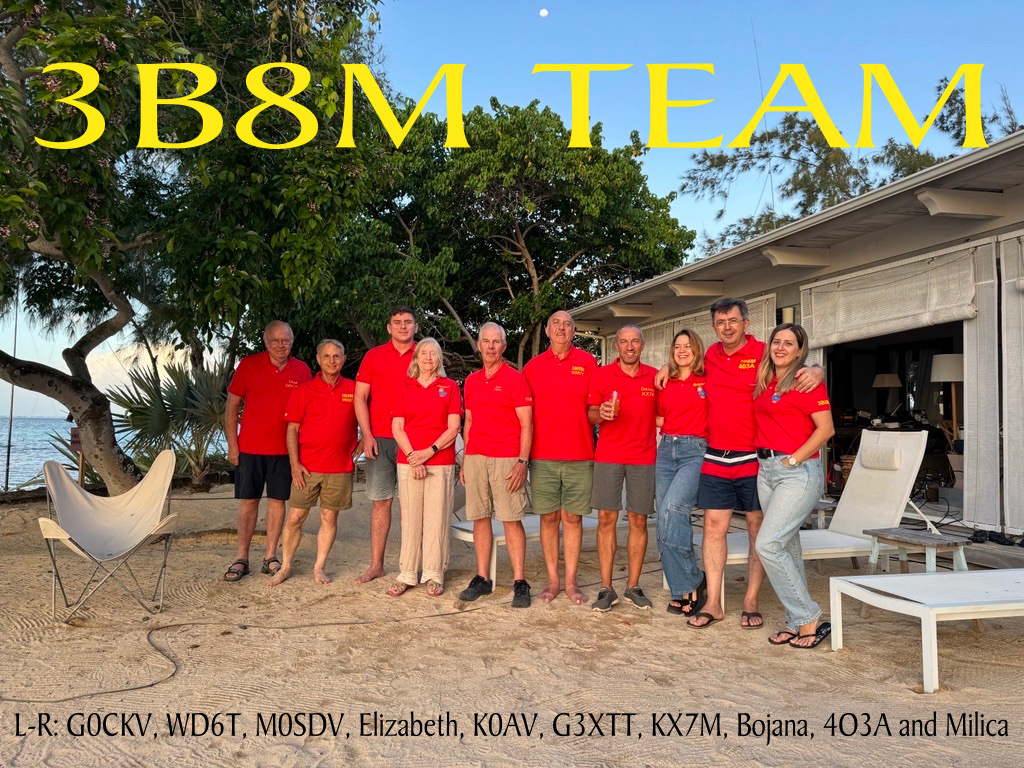
Olof G0CKV describes below the 2023 3B8M Contesting experience.
We enjoyed another instalment of our 3B8M adventure in 2023. The trade winds provided natural air conditioning, unknown birds sang for us, the ocean waves hitting the reef added a soothing noise effect, the views of the sunsets and sunrises and the full moon over the lagoon distracted us. For added context we occasionally checked the UK weather forecast.
A great team with some new operators meant more know-how and experience shared and also new dynamics. Antennas went up quickly and were taken down at record speed. The problems of the world were discussed and sorted under the stars on our veranda/shack.
3B8 is very far away from amateur population centers. Low elevation angles matter. The large majority of our QSOs are towards the NW – same direction for EU and NA. Our QTH is right on the ocean so we use verticals to benefit from their superb low-elevation pattern when they can have salt-water in the Fresnel zone.
Being far away also means long journeys and jet-lag. Then there is only so much you can pack in your luggage. Good planning is required. On an in/out field-day-style operation there is no time to find bits and pieces locally and they would probably not be available at any rate.
There is no chance to win the world from such a distant location as 3B8 – the bands are just not open enough hours and the distance means weaker signals in general. So we don’t do this to win but to have fun and learn from each other and then find ways to improve year by year.
As an upgrade this year we used broadside arrays of 2-element VDAs and an omni vertical dipole for 20-15-10. The operator could select one broad VDA towards NW, two phased VDAs towards NW or an omni vertical dipole.
On the low bands we have used the same setup for a few years. For 160 we use a vertical on an 18m pole top loaded with 4 wires, on 80 another 18m pole with an inverted-L and for 40 a vertical dipole on a third 18m pole placed out on a rock in the lagoon. Strong winds one day and high tide another day required some retuning Saturday before sunset and work on the radials on Sunday before sunset.
To improve our low-band reception and more quickly pull callers out of the noise we again experimented with receive antennas. A single K9AY was placed out on a rock in the lagoon. The prepared termination box for the K9AY was the only item that we (that is I) somehow forgot to pack so we improvised using a large FT43 toroid to build a transformer and a resistor kindly donated by a local resident ham. The K9AY was fed to a 40-80-160 triplexer followed by separate preamps for each band. We experimented with diversity receive.
Propagation at our latitude was fine but not as good as last year. 10 opened later and closed earlier than expected, 15 did OK almost around the clock, 20 was dead midday +/- 3 or 4 hours, 40 was good as usual an hour or so before our sunset until 1-2 hours after sunrise. The low bands performed much worse than last year. Noise on the bands was actually lower but the signals we heard were also low. We called and called but the stations we called didn’t seem to hear us. Was this all an effect of the high solar flux providing increased attenuation on our latitudes right under the sun in local summer? Generally we had the impression that E/W paths up in northern latitudes were better than N/S paths but that may well have been our imagination.
With our team of 7 operators we had planned to run six stations but given the low-band condx down here we shared 80/160 on one station. As usual we used K3 radios with SPE amplifiers but this year we also used a Flex6700 with a 4O3A amplifier. We had no technical issues during the contest. With the help of our filters and stubs and carefully planned antenna placement we had almost no inter-station interference issues at all. The harmonics from 40 into 20-15-10 were as always the most obvious but that could easily be handled by operating a bit up on 40. High tides messed up our 80 and 160 radials but we spotted that and adjusted; strong winds broke loose a top-loading wire but that was also spotted and easily fixed.
Our major problem is getting the balance right between antenna ambitions and making time available to relax and enjoy the exchange of radio stories in good company and in a quite exceptional setting. We had the opportunity to meet up with local 3B8 friends a couple of times – a great way to learn more about a fascinating and beautiful country. Click to view photos on this link.
If my arithmetic is correct we worked 12 unique calls from EI, 138 G, 3 GD, 5 GI, 25 GM, 1 GS, 2 GU and 9 GW. We had 6-band QSOs only with G6XX and M6T this year. We had 5-band QSOs with EI7M, G0BNR, G3vMW, G4IIY, G6T, GS7V and MD4K. Final Score: 24 596 754
Team in 2023 included 4O3A, G0CKV, G3XTT, K0AV, KX7M, M0SDV, WD6T.
3B8M will be back next year.
Olof G0CKV